More Thoughts on the Gulag
I've gotten to the point where for the most part, I've become an opportunistic book buyer. I used to go looking for specific books and I would (mostly) buy the book I was looking for before buying anything else. Now, there are so many books that I want to read that unless it's by one of my rare "must have" authors, I don't bother until I find it cheap somewhere around town, whether it's in a used book store, or even better, at a yard sale. This week I picked up a nice paperback copy of Thackery's Vanity Fair. Eventually I'll read it.
I've already written about volume I of The Gulag Archipelago which I found as a paperback at the local YMCA's used book sale. Early this summer I found volume II in hardcover at a used book store. It's big, and it's heavy, and I'm guessing that very few people bought it, and even fewer people read it.
I am not like other people however, and I brought it to keep me company on the six hour train rides to and from Chicago. It is truly as fascinating as the first volume. As with the first volume, the irony and sarcasm keeps this book from making the reader suicidal.
With about 200 pages left to go, it suddenly hit me that a totalitarian society - as the USSR, as the other communist dictatorships, as the Third Reich, as Islamic countries are and always have been - suicidal. No, that's not right. They still survive. They are self-defeating. They can never rise up from the mud because they destroy their best and brightest. Solzhenitsyn writes of engineers, scientists, writers, composers, poets, artists, and others who should have been inventing and creating new products, and building the wealth, and forming the spirit of the USSR, being instead, forced to live as political prisoners and slave laborers in prison camps across Russia. Lenin had his opponents murdered, and the entire slave labor system began under his leadership. Stalin, in addition to imprisoning and killing the best and brightest Russia had to offer, purged his generals before WWII. Oops! And then there was China. How many brilliant, creative, hard-working people were murdered during the Cultural Revolution and the Great Leap Forward? Under Pol Pot in Cambodia, people with glasses were killed under the assumption that they were dangerous intellectuals. How many political prisoners has Castro imprisoned?
You want to talk non-communist dictators? How about Zimbabwe's Mugabe turning a net food exporting country into a nation of starving disease-ridden beggars? Yes, the Rhodesian apartheid system was immoral, but are Zimbabweans better or worse off now?
Islam, although it has conquered a large portion of the world, as its holy book, the Qu'ran instructs its followers to do, it doesn't allow Muslims to rise in the world in any meaningful manner. Jihad doesn't allow for excellence in fields that improve the lot of mankind, there is no incentive to create and nurture industry, medicine, art, literature, etc. It's all about conquest and control over the lives of Muslims - and non-Muslims. We are supposed to be tolerated as dhimmis. Not that Islam has contributed nothing, but considering 20 percent of the world's population is Muslim, it seems to me that if there were genuine freedom in Islam and in Islamic nations, we would hear more positive news and less of the kind that insists we in "dar al harm" ignore the pathologies of Islam; jihad, honor killings, terrorism, rioting over cartoons, teddy bears, literature, etc.
But back to the gulag. As I was dawdling with this post over days and weeks, I finished the book. Turns out it's also a philosophy book. And it's not that Solzhenitsyn just tacked some philosophical musings on at the end to give it a bit more kick. Due to the previous 12 to 1300 pages, it is an integral part of the book. It fills a need that the reader (or at least this reader) doesn't even realize needs to be filled until it is filled. He has built a philosophy built on pain and death and the horrors of a slave labor system that is as bad or worse than any other that has ever been conceived by human beings. And I'm not sure he's totally satisfied with this philosophy, but he doesn't excuse himself as a victim. He doesn't "go Obama" on us. He presents his own weakness and fallibility to the reader. (I can't pretend that I would have done any better in his situation. In fact, I don't think I would have lasted very long at all.) He doesn't offer himself as a hero, but merely as another innocent Russian unjustly imprisoned who happened to be lucky enough to survive. His survival amidst all of those who died forces him and the reader to continue to think about the validity of these final thoughts. It also reminded me of Tolstoy's story,
God Sees the Truth, but Waits.
I hate to gush, but it you have some spare time, you should read this monster.
Labels: books, Gulag Archipelago, islam, Obama, Russia, Solzhenitsyn
The Gulag Archipelago - Parts I and II
I've been meaning to for years, and I finally read
it. I finally read the first volume of The Gulag Archipelago. I could have put it off longer, but I found a paperback copy for a quarter at a yard sale. Then I needed something for the trip to NYC. With all the time one spends at the airport these days when one flies, a
hunk of good solid reading material is a must.
This is certainly good solid reading material and it kind of blows the lid off of any thoughts anyone may have of any kind of socialist utopia where "from each according to his ability, to each according to his need" is possible. And that line about "Workers of the world, unite. You have nothing to lose but your chains"? Forget it. It's more like, "Fools of the world, unite. Exchange your current manageable chains for chains that will drag your body down the same way you've dragged your mind down if you still don't understand that
communism is a mug's game.!"
Under the circumstances, this could have been a hideously depressing book and impossible to read. In fact, judging from the heft of the book and the number of used copies I've seen over the years, my guess is that more people bought it than read it. A lot more. I also have to surmise that even fewer people bought or read the second volume containing parts III and IV. (I picked that up yesterday at one of our better area used book stores. It's on my book shelf now, and I'll get to it eventually.) Solzhenitsyn softens the pain considerably with his constant sarcastic tone. No, the reader doesn't laugh along with him, but the reader shares the frustration and the irony of a system that some people today still worship as the greatest hope for mankind, but that arrested millions of innocent men and women in order to maintain control over citizens and to feed the gigantic slave labor pool that was needed to build projects that wouldn't have been able to be built otherwise. Let's face it: a controlled economy is no economy and that's what the Russians had under communism. For some of the true believers who were arrested on trumped up charges or on no charges at all, it was the shock of being caught in the system they supported that gave them the realization that something wasn't quite right here.
As musician, poet, and philosopher(?)
Sun Ra said,
If you do wrong, you have to pay,
But if you do right, you have to pay too;
Also, if you do nothing
You have to pay.
And it didn't start under Stalin, as some of the apologists would like us to believe. It built upon the prisons and police force of the czars. The inhumanity of the system was taken light years beyond anything the czars ever imagined. And it was taken there by Lenin and his henchmen.
Solzhenitsyn doesn't settle for merely telling his own story as a prisoner of the gulags. His is only one of hundreds that he shares. He also gives a history of the system, and a tour of the system, from his arrest to his arrival at some of his work projects. In between we get others' stories of both intentional and casual cruelty. While the conditions were almost uniformly horrible throughout the system from arrest, through transport, to prisons and work camps, Solzhenitsyn talked to other prisoners. Many of them, of course are long dead, having died somewhere along the way. Some prisoners, like Solzhenitsyn got lucky and were imprisoned in places where it was possible to not be worked to death.
While describing the horrors of the system, and according to him, Soviet jailers were much worse than Nazi jailers, as he met prisoners who were unfortunate enough to experience both, he also writes of the pleasures of talking to other prisoners, intelligent men and women who had important stories to share, of being able to read the occasional great book. He looked for and reported on the positive in a man-made hell.
By the time Solzhenitsyn was arrested the system had been functioning for years and ran like a well-oiled machine. Arrests were done at night so that the befuddled victim was less likely to fight back. Very few, including the author, did. From that point on, the cruelty built. Some of it, including interrogation and torture, was to break the prisoner in order to get false confessions and names of other "conspirators". And some of it was just to keep the system running more efficiently. Prisoners died at every step. Those who lived were moved to the next step, until finally he, or she, ended up at one of the gulags to, most likely, be worked to death.
I'm not sure a lesser writer could have pulled this off. The only part where it drags is in his review of many of the more notorious show trials. Other than that, it's a fascinating look into another facet of man's inhumanity to man.
In closing, I have to share a piece of advice from Solzhenitsyn. It's on page 591 of the paperback edition:
“Do not pursue what is illusory – property and position; all that is gained at the expense of your nerves decade after decade, and is confiscated in one fell night. Live with a steady superiority over life – don’t be afraid of misfortune, and do not yearn after happiness; it is, after all, all the same: the bitter doesn’t last forever, and the sweet never fills the cup to overflowing.
“It is enough if you don’t freeze in the cold and if thirst and hunger don’t claw at your insides. If your back isn’t broken, if your feet can walk, if both arms can bend, if both eyes can see, and if both ears can hear, then who should you envy? And why? Our envy of others devours us most of all. Rub your eyes and purify your heart – and prize above all else in the world those who love you and who wish you well. Do not hurt them or scold them, and never part from any of them in anger; after all, you simply do not know; it might be your last act and that will be how you are imprinted in their memory.”
Labels: Gulag Archipelago, Russia, Solzhenitsyn, Soviet Union
Alexander Solzhenitsyn
I can't add much to what's already been written upon the death of Alexander Solzhenitsyn. I remember the hoopla surrounding his exile to the United States back in the 70's. I remember people writing about his books. I even read one, One Day in the Life of Ivan Denisovich. I'm sure that's the one that most other people read who only read one of Solzhenitzyn's books. It's short. But it's a great book. I reread it about a year ago. I got the greater appreciation of it that comes with age, experience, and the knowledge that, although it is a work of fiction, it's based on facts that he and millions of Russians had lived through, and that others still live through today, whether in Russia, or one of the other tyrannies on this planet. I also remember reading an interview with him. He said the book was based on a good day in the gulag. We wouldn't be able to stand reading about a bad day.
Over at
American Digest, there's a link to
Solzhenitsyn's 1978 Harvard commencement speech. It packs quite a punch. He didn't think the American mall culture was all that great. Living only to hoard vast quantities of merchandise was not his idea of a life well spent. He also condemned the lack of courage in our elites.
A Decline in Courage [. . .]
may be the most striking feature which an outside observer notices in the West in our days. The Western world has lost its civil courage, both as a whole and separately, in each country, each government, each political party and of course in the United Nations. Such a decline in courage is particularly noticeable among the ruling groups and the intellectual elite, causing an impression of loss of courage by the entire society. Of course there are many courageous individuals but they have no determining influence on public life. Political and intellectual bureaucrats show depression, passivity and perplexity in their actions and in their statements and even more so in theoretical reflections to explain how realistic, reasonable as well as intellectually and even morally warranted it is to base state policies on weakness and cowardice. And decline in courage is ironically emphasized by occasional explosions of anger and inflexibility on the part of the same bureaucrats when dealing with weak governments and weak countries, not supported by anyone, or with currents which cannot offer any resistance. But they get tongue-tied and paralyzed when they deal with powerful governments and threatening forces, with aggressors and international terrorists.
Should one point out that from ancient times decline in courage has been considered the beginning of the end?
and
no weapons, no matter how powerful, can help the West until it overcomes its loss of willpower. In a state of psychological weakness, weapons become a burden for the capitulating side. To defend oneself, one must also be ready to die; there is little such readiness in a society raised in the cult of material well-being. Nothing is left, then, but concessions, attempts to gain time and betrayal.
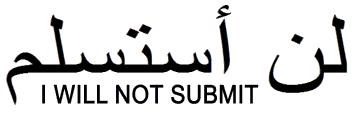
From 1978 until today I think things have only gotten worse. Facing the Islamofacists, many of our leaders, our MSM, and our intellectual elites have gone even further into their default mode of preemtive surrender. Those of us who refuse to submit are marginalized. We're called racists, Islamophobes and worse. Much like the image of the terrorist is softened by referring to Hamas and Hezbollah as "militants" and "extremists", we who try to get our leaders to fight against them (or at least call them by their proper title) get also get labeled as extremists. Somehow, sitting at a computer writing about the dehumanizing aspects of Sharia law and questioning why so many in the West are submitting to the demands of a theocratic, totalitarian movement firmly lodged in a seventh century desert culture, makes us the equivalent of Islamic murderers of infidel women and children.
Back when I was young, and manufacturing jobs were being lost to automation, many writers,(including Eric Hoffer, which proves that nobody is 100% right) predicted that people would now have more time to devote to study and would be able to make time for science, history, philosophy, and the general improvement of the intellect and the soul. Who could have predicted that with so many "great shows" to watch on TV, that there wouldn't be as much time for self-improvement as we thought?
Right now, I'm near the end of Tacitus' Histories. In it, he relates the period of civil wars between the death of Nero and the ascension of Vespasian to the post of Emperor. In between those two, there were three other very short-term emperors who ruled for as long as their loyalists could keep them in power. The whole period was about a year long. One of Tacitus' themes in this work, and apparently it's echoed by other ancient historians, is that extended periods of peace make us weak and lazy. He gives examples of Roman legions being given too much freedom or too much laxity, and then being useless in battle, or worse, becoming whiners, not willing to do their jobs, attacking their commanders, and degenerating into mobs. According to Gibbon, if I remember correctly, this period of history is shortly after the beginning of the decline of the Roman Empire.
So we don't want to fight for our own freedom. We want to shop for goofy stuff, as shown in
this post at Pen of Jen, and hope that all of the bad things go away by themselves (or maybe if we are really good, and we vote correctly in November, the Obamessiah will create a progressive utopia for all of us).
Personally, I prefer peace. I've changed though. I understand now, as I didn't understand very well as a young punk, that there are times when you do have to stand up and fight for what you believe in, because if you don't, someone will take valuable things away from you, you know, things like liberty, freedom, and perhaps your life. I understand that we in the United States do have enemies that want to destroy us in the worst way and that we have to defend ourselves against them. I understand that we, like other western nations have lost some of the moral clarity that allows us to do what we need to do. Look what's
happening in
Canada. They are slowly, in the name of multiculturalism and freedom from insult, knuckling under to the demands of the Islamists in their midst.
Has peace and the greatest prosperity in the history of mankind caused us to lose our spiritual way? The following quote is another piece of Solzhenitsyn's speech, but Tacitus might agree with it.
If humanism were right in declaring that man is born to be happy, he would not be born to die. Since his body is doomed to die, his task on earth evidently must be of a more spiritual nature. It cannot unrestrained enjoyment of everyday life. It cannot be the search for the best ways to obtain material goods and then cheerfully get the most out of them. It has to be the fulfillment of a permanent, earnest duty so that one's life journey may become an experience of moral growth, so that one may leave life a better human being than one started it. It is imperative to review the table of widespread human values. Its present incorrectness is astounding. It is not possible that assessment of the President's performance be reduced to the question of how much money one makes or of unlimited availability of gasoline. Only voluntary, inspired self-restraint can raise man above the world stream of materialism.
I admit, I want stuff. I want specific stuff, but it's still stuff. I want books. I could spend a huge amount of money on the books I want. I could spend another huge amount on the CD's that I want. I don't need them, but I want them. It's an aspect of my life I have to examine.
Solzhenitsyn has given me a lot to think about. At some point, when I have a few extra dollars in my pocket, I'm going to pick up a used copy of The Gulag Archipelago. They're all over the place in every used book store I visit. I've seen them all the time for years, but like everyone else, I paid no attention to the book until the death of the author put it back in the public eye. I imagine it was due to the size of the book, but a lot of people who bought it, dumped it without reading it. That's good for me because I'll be able to get a nice used copy cheap and have many hours of reading pleasure. And I think it's a book worth owning so I can justify buying it. It's not just stuff. It's a twentieth century classic by a Nobel prize winning author and man who demonstrated more bravery and fortitude than I hope I ever have to demonstrate.
Labels: books, Solzhenitsyn, Tacitus
War's legitimate object is more perfect peace. Flavius Vegitius Renatus
This is an optional footer. If you want text here, place it inside these tags, and remove this comment.


 CHALLAH AKBAR